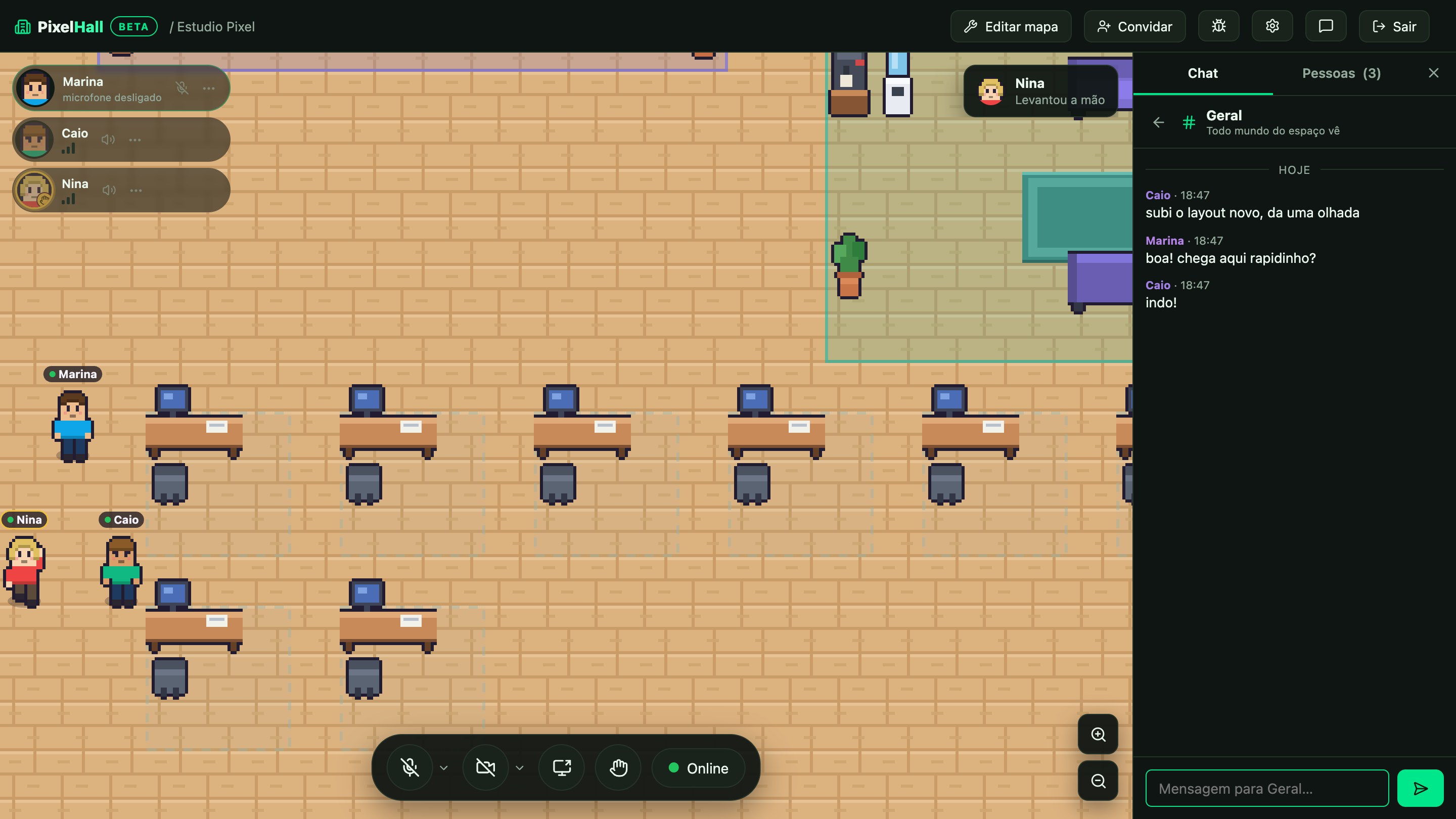
A pixel-art virtual office that runs in the browser: your team walks around the map, gets close and talks. Proximity audio, video, screen sharing, lockable rooms and a desk for each person. The plan covers the space, not each head.
Free for up to 10 people at the same time · no card · nothing to install
Nobody swaps virtual offices for fun. These are the reasons we hear most often from the teams that reach us.
When the price is per person, inviting someone to a meeting becomes a budget decision. In PixelHall the plan covers the space: the price is the same with 5 or 30 people inside it.
A client, a candidate, a freelancer — nobody from outside should have to create an account or download anything. In PixelHall a guest joins through a link with an expiry date, typing only their name.
Most teams want the essentials working well — presence, voice, video, screen — not a catalogue of things to configure. The office is generated ready to use, and the editor changes whatever you want.
Voice and video travel straight between browsers, with no media server in the middle, and the quality follows the size each person is watching at. Nothing to install, and it works on the phone too.
Use this list to size up any virtual office — ours included. The right-hand column is what PixelHall does today.
| What to check | In PixelHall |
|---|---|
| How the price grows | Per space, not per person. Four fixed monthly tiers; the same price whether the space is empty or full. |
| What you get for free | The whole product, up to 10 people together, no card. No feature hidden behind a plan. |
| Installation | None. Runs in the browser, on the computer and on the phone. There is an optional desktop app for Windows. |
| Proximity audio | Yes. In the open hall the volume fades with distance, and you can see on the map how far your voice reaches. Inside a room everyone hears everyone equally. |
| Keeping a conversation private | Lockable rooms. Whoever arrives knocks and you decide whether to open. Nobody outside a locked room can listen. |
| A fixed spot for each person | A reserved personal desk per member, with a keyboard shortcut to go there and a lock for focus time. |
| How guests get in | A link with an expiry date, name only. No account, no download. Revoke the link and the access ends. |
| Where voice and video travel | Straight between browsers (P2P), with no media server in between — one less middleman, less delay. |
| Presenting | A shared screen becomes a stage for the whole space, with the cameras on a rail beside it and quality matched to the size each person sees. |
| Languages | English, Portuguese and Spanish in the product and on the public pages. |
| Trying before paying | 7 days on any paid plan, cancelled from the payment portal without talking to anyone. |
We only speak for ourselves. Any other tool's features and prices change over time, so we would rather you check them at the source and compare against this column — than trust a table we drew up.
In the open hall you hear the people near you, with the volume fading with distance. Inside a room everyone hears everyone — and nobody outside listens.
Share your screen and it opens front and centre for everyone, with the cameras beside it. Esc closes the stage and gives the map back.
Sensitive meeting? Lock the room: whoever arrives knocks and you decide whether to open. Unlock it and it is an open room again.
Members pick their own desk and it stays reserved. Going to your desk is a keyboard shortcut — and you can lock it to focus.
The office is generated from the size of your team and the layout you choose. After that, the editor moves rooms, desks and objects.
Members have an account, a desk and always get in. Guests join with just their name, through a link with an expiry date. Revoke it and the access ends.
The plan caps how many people are in the space at the same time. Members have a guaranteed seat and always get in; the remaining seats take guests.
The free spaces of the beta have run out — we are working on releasing more. In the meantime, trial any plan for 7 days.
Start for free7-day trial on any paid plan: add the card, use everything for a week, and the first charge only happens at the end of the period. Cancel before that and you pay nothing.
It is an independent product in the same category: a virtual office with a map, characters and proximity audio, running in the browser. We have no affiliation, partnership or relationship with Gather, and PixelHall is not derived from it — it was written from scratch.
The plan covers the space, not the person. Free for up to 10 people at the same time, no card. The paid tiers are Start (15 people, US$ 30/mo), Team (25, US$ 50/mo) and Office (35, US$ 70/mo), all at 50% off for the first 6 months of the launch.
No. PixelHall runs entirely in the browser, on the computer and on the phone. There is an optional desktop app for Windows, with a bar that follows you while you share your screen, system notifications and a global mute shortcut.
There is no map import from other tools. Building the new one takes two minutes instead: you say how many people you expect and pick a layout, the office comes out with rooms and desks to match, and the editor changes whatever you want afterwards.
No. Members have an account, a personal desk and always get in. Guests join through a link with an expiry date, typing only their name — and revoking the link ends the access immediately.
It fits the Office plan, which holds 35 people together. The cap counts people at the same time: each member takes a fixed seat and always gets in, and the seats left over take simultaneous guests.
Cancel straight from the payment portal, without talking to anyone. The space returns to the free plan, nobody is thrown out, and only new arrivals have to fit the smaller cap.
Create the space, send the link to your team, and see what talking while walking around a map feels like.
Create my office for free